Are Guns Allowed on Military Bases Now? What Changed Under the Pentagon's New Policy
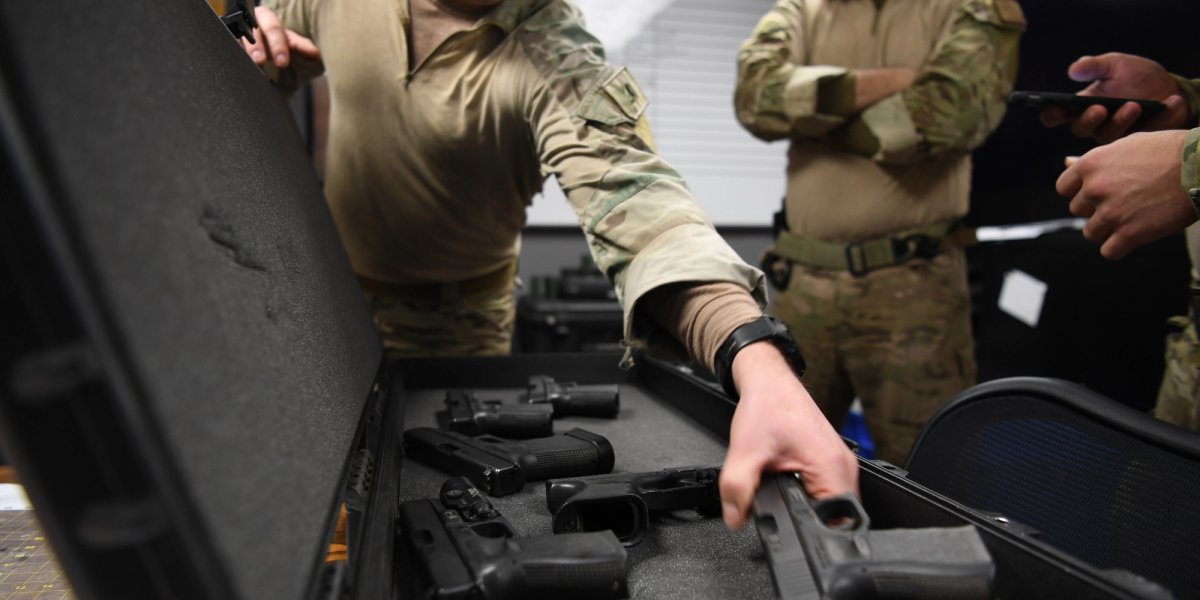
The Pentagon changed how firearm requests are handled on base. Earlier this month, the U.S. Department of Defense released guidance requiring installation commanders to create a process for service members to request authorization to carry privately owned firearms while off duty on base. Those requests are to be reviewed with a “presumption of approval.” If a request is denied, the decision has to be written and tied to a specific reason connected to the individual.
What Happens When a Request Is Submitted?
Carrying a privately owned firearm on base still requires command approval. A formal request is submitted. It is reviewed under a presumption of approval. If denied, the decision must be documented and explained as it pertains to that individual.
Where that request goes, and who signs off on it, depends on the installation. In most cases, that authority runs through a service member’s chain of command, often alongside base law enforcement or security offices.
This isn’t a huge sweeping change. The directive requires a process and it does not define a single system across installations, as approval is dependent upon the specific command.

Who This Applies to and Who It Does Not
The directive applies to service members on U.S. military installations. It does not extend to civilians, contractors, spouses, or dependents. There is no automatic carry rule. Each request still requires command approval.
For military families living on base, the directive does not change who is eligible to carry. This affects service members only. Any authorized carry remains subject to, “Applicable laws, regulations, and installation-level policies.”
That includes rules tied to controlled facilities, operational spaces, and installation-specific firearm requirements already in place.
The directive does not define how firearms must be carried, whether they can be open or must be concealed, and does not replace existing rules on registration, storage, or transport.
The Legal Authority Behind It
The directive references authority under the Fiscal Year 2016 National Defense Authorization Act, which allows commanders to authorize firearm carry for personal protection on military installations.
Daily life on base continues under existing restrictions. Housing areas, schools, commissaries, and workplaces remain governed by installation rules already in place.
Approval under this policy does not override those boundaries. What changes is in the request and approval process, not in where firearms are broadly permitted.

What Changed and What Didn’t
The directive requires a process, but it does not define how that process is built. Commanders remain responsible for implementation, including how requests are submitted, reviewed, and documented.
The Associated Press reported that personal firearm carry on base, outside official duties, has historically been tightly restricted. Service members can request authorization to carry a privately owned firearm while off duty, on base.
That request is reviewed with a presumption of approval. If denied, the decision must be written and justified. Command authority remains in place, restrictions stay the same, and eligibility hasn’t expanded. The process has changed, the rules have not.
Continue Reading
National Guard’s $292 Million Housing Contract Will Move D.C. Troops Out of Hotels

A Permanent US Military Base in Poland Could Soon Become Reality
200 Faiths Down to 30: What the New Religious Code Consolidation Means for Your Personnel Records
Join the Conversation

Natalie Oliverio
Veteran & Senior Contributor, Military News at MyBaseGuide
Natalie Oliverio is a Navy Veteran, journalist, and entrepreneur whose reporting brings clarity, compassion, and credibility to stories that matter most to military families. With more than 100 publis...
Natalie Oliverio is a Navy Veteran, journalist, and entrepreneur whose reporting brings clarity, compassion, and credibility to stories that matter most to military families. With more than 100 publis...
Credentials
- Navy Veteran
- 100+ published articles
- Veterati Mentor
Expertise
- Defense Policy
- Military News
- Veteran Affairs
SHARE: