
The Pentagon Wants to Mass-Produce Laser Weapons by 2028
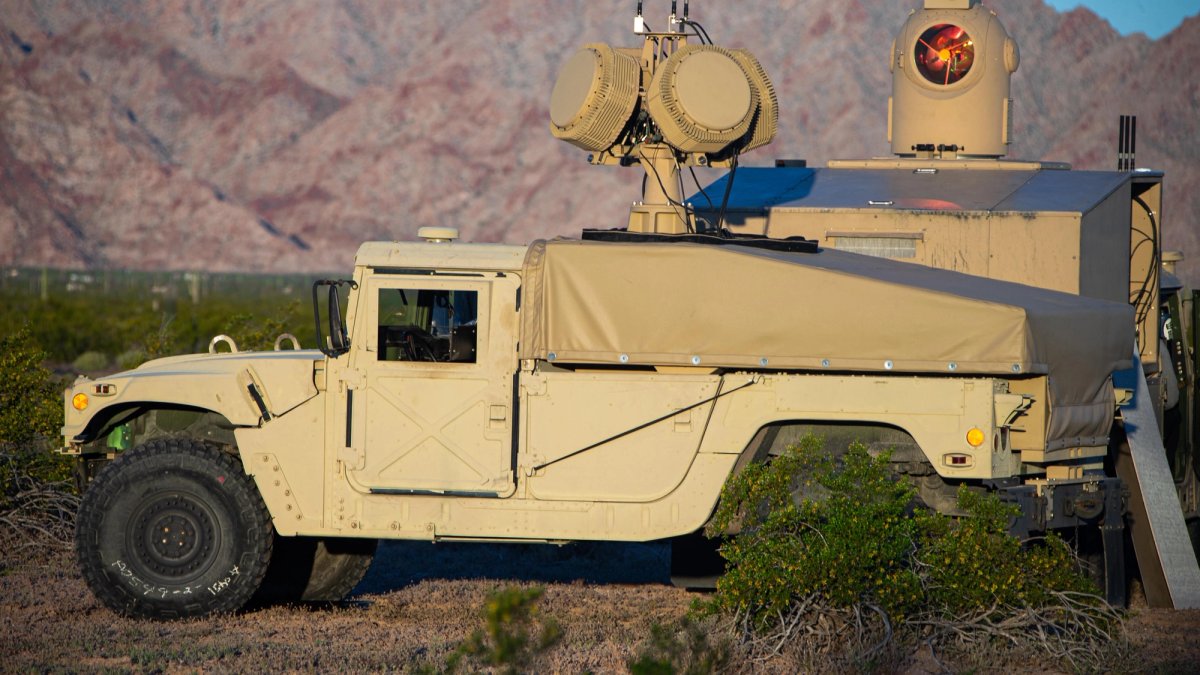
The U.S. military has been promising battle-ready laser weapons for decades. Today, the Pentagon is closer to fielding operational directed energy weapons than ever before. The next few years will determine if that is wish-casting or a real path to operational weapons.
Lasers have been on the battlefield since the 1970s as targeting aids, covert markers for airlift, and more recently as “dazzlers” to attempt to defeat optical sensors or blind human crews. High Energy Lasers (HELs) have been the goal for decades, but solving the engineering problems has been the roadblock. That roadblock may be clearing.
The US has begun fielding a variety of directed energy systems, including HELs, and, according to Undersecretary of Defense for Research and Engineering Emil Michael, it is nearing the point where laser weapons can be produced at scale.
Testifying before the Senate Armed Services Committee in May, Michael told lawmakers the science of laser weapons is "largely done." The Pentagon, he said, is now focused on the engineering challenges of turning exquisite prototypes into mass-producible systems.

What’s Already Fielded
The Navy has made more progress than its sister services. Ships are excellent platforms for directed energy systems, as the power plants of many Naval vessels are capable of delivering enough power to make the system worthwhile as a weapon. Current directed energy systems also tend to be heavy and bulky, and not yet suitable for deployment on a land or air vehicle.
The destroyers that prosecuted Epic Fury reportedly went into the fight with roughly three-quarters of their missile magazines committed to self-defense. Laser weapons that fire at pennies per shot aren't a nice-to-have in that environment - they're an operational necessity.
Directed energy systems are currently deployed on nine surface combatants, split between two capabilities. The Optical Dazzling Interdictor, Navy (ODIN) - a lower-powered dazzler designed for counter-ISR and soft-kill against small drones - is the more widely distributed system, with confirmed deployments on multiple Arleigh Burke-class destroyers. The 60 kW High Energy Laser with Integrated Optical Dazzler and Surveillance (HELIOS) system aboard USS Preble (DDG-88) is the real article, a true high-energy laser integrated into the Aegis Combat System that downed four drones in a 2025 fleet exercise and was operationally deployed during Operation Epic Fury.
However, in his testimony to the House Appropriations Committee, then acting-Chief of Naval Operations Admiral James Kilby reported that HELIOS had not reached full power during testing, despite prime contractor Lockheed-Martin’s insistence otherwise, and also despite successfully downing drones in exercises. Subsequently, the FY2026 DoD budget zeroed out the program, and HELIOS appears to be headed for decommissioning.
The Army has been developing directed energy weapons for more than a decade for air defense. As drone warfare proliferates, seemingly logarithmically, the need for rapid and cheap defense against them has become urgent. The Army's 50 kW Stryker-mounted Directed Energy Maneuver-Short Range Air Defense system was determined "not mature enough" to become a program of record after rocky testing exposed problems with heat dissipation and reliability in its vehicle-mounted configuration.
The Marine Corps returned its five Compact Laser Weapon System units to Boeing with no replacement in sight. The Air Force tested Raytheon's High-Energy Laser Weapon System for years before abandoning it without a program of record.
Directed Energy Weapons Around the World
Adversaries aren't waiting for the Pentagon to solve its acquisition problems. The US isn’t alone in fielding directed energy systems, and just like the drones that have become ubiquitous on the battlefield, the demands of war have accelerated directed energy technology. A spectacular video shot from the deck of a ship in the Russian naval base at Novorossiysk showed Russian defenders attempting to defeat a Ukrainian attack drone employing a bright blue commercial off-the-shelf (COTS) 445nm gallium nitride (GaN) laser.
The drone hit its target anyway, but the video demonstrates that directed energy weapons are becoming more common. According to Jared Keller of Laser Wars, 19 countries have fielded directed energy weapons. The usual defense technology leaders are there, of course, the US and China, but other members of the laser weapons club include Russia, Saudi Arabia, Iran, Pakistan, India, and several NATO countries.

Operational Energy Weapons by 2028?
There is reason for skepticism. A 2023 Government Accountability Office report found a common thread running through previous failures to move from R&D to operational deployment: promising prototypes were advanced without transition partners, without binding agreements between developers and the acquisition community, and without shared funding commitments across budget cycles. When priorities shifted, and in Washington, they often do, the programs simply died from a lack of programmatic funding.
So what's different this time? Two things, potentially.
First, President Trump's "Golden Dome for America" domestic missile defense initiative has put a hard deadline and real money behind directed energy. The Pentagon's FY2027 budget request contains $452 million in proposed R&D spending for directed energy in support of Golden Dome alone - more than triple what was enacted under the reconciliation package Trump signed in July 2025. A directed energy demonstration tied to the Golden Dome is planned for the summer of 2028.
Second, the Army's Enduring High Energy Laser (E-HEL) program - a modular 30 kW system designed explicitly as the service's first directed energy program of record - appears to be moving faster than almost any laser effort before it. Its design philosophy looks like a direct answer to DE M-SHORAD's failures, decoupled from any specific vehicle platform and built for maintenance by soldiers who aren't laser specialists.
The Iran experience is adding operational urgency. The war has demonstrated that the voracious consumption of high-end and expensive missiles to destroy cheap drones is not sustainable. Given the lack of current capacity to replenish the magazines of THAAD, Patriot, and other systems, rapid funding of directed energy weapons has moved to the top of the funding priority list.
In his recent testimony to the Senate, Michael noted that the military's experience in the Iran War had "doubled" the Pentagon's interest in directed energy systems - a detail that budget numbers alone don't capture. Still, serious questions remain on the industrial side. The building blocks for laser weapon production - specialized optics with 12- to 18-month lead times and critical materials sourced from Chinese-dominated supply chains - do not yet appear to be in place to enable production at the scale Michael is describing.
The engineering problems that prevented previous systems from meeting desired operational metrics remain. Building and fielding a directed energy system powerful enough to destroy the target, while simultaneously making it survivable and robust enough to survive the rigors of combat, is a daunting task. If industry is successful at delivering a genuinely deployable system rather than another impressive prototype, it will be the first time the U.S. military has successfully made that transition.
Continue Reading

Family Separation Allowance Is Now $300/Month: What Every Military Family Must Know

The 2027 DoD Per Diem Rates Are Released. Here’s How Your Travel Budget Has Changed

National Guard’s $292 Million Housing Contract Will Move D.C. Troops Out of Hotels
Join the Conversation

Mickey Addison
Military Affairs Analyst at MyBaseGuide
Mickey Addison is a retired U.S. Air Force colonel and former defense consultant with over 30 years of experience leading operational, engineering, and joint organizations. After military service, h...
Mickey Addison is a retired U.S. Air Force colonel and former defense consultant with over 30 years of experience leading operational, engineering, and joint organizations. After military service, h...
Credentials
- PMP
- MSCE
Expertise
- defense policy
- infrastructure management
- political-military affairs
SHARE: