The Pentagon Is Pulling Back Forces Once Reserved for a European Crisis

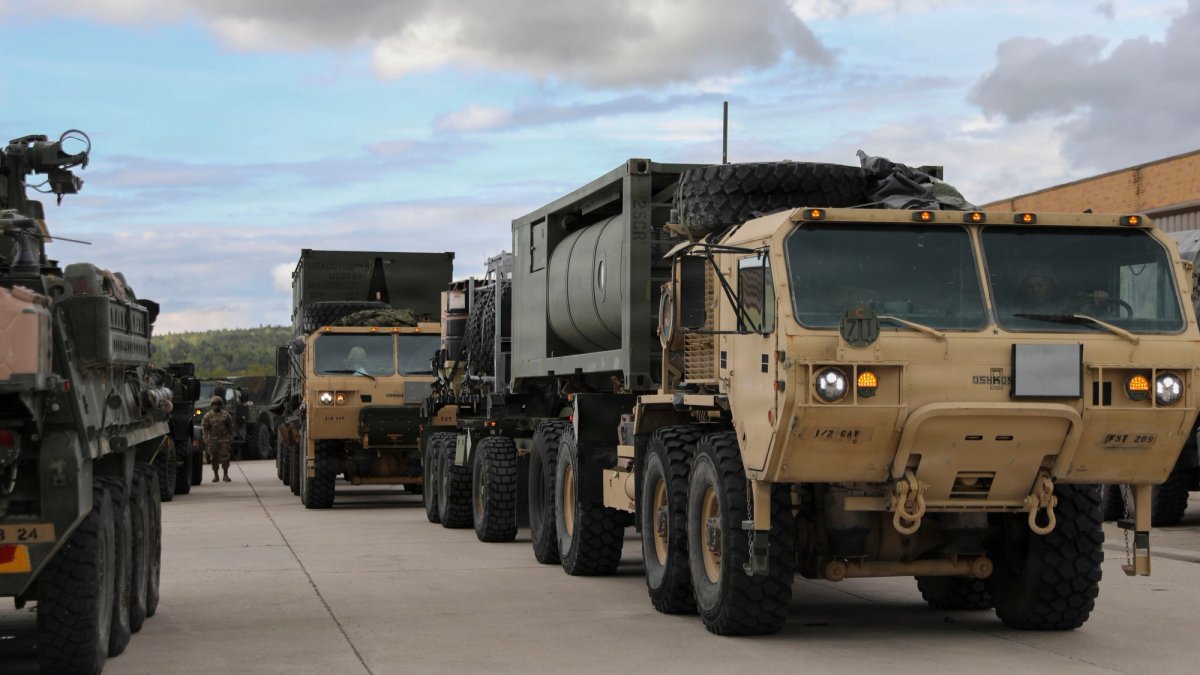
Over the past month, the Pentagon has issued four distinct announcements that, taken together, represent the most significant reshaping of America's military commitment to Europe since the Cold War ended. Each announcement arrived separately, with minimal context, and none came with a coherent strategic rationale.
But the cumulative picture is clear: the United States is deliberately reducing its European deterrent posture at precisely the moment Russia continues its war against Ukraine, and NATO's eastern flank remains under persistent threat.
Announcement One: The 5,000-Troop Withdrawal from Germany
On May 1, Pentagon spokesman Sean Parnell announced that the United States would withdraw roughly 5,000 troops from Germany following "a thorough review of the Department's force posture in Europe." Other than the headline, that withdrawal is scheduled to take place over the next six to 12 months, though the Pentagon offered few details about which troops or operations would be affected.
The 5,000-person reduction in troop strength is not, in and of itself, significant since it put the numbers back to pre-2022 levels. As of December 2025, 36,436 U.S. active service members were stationed in Germany. At the height of the Cold War, roughly 250,000 active-duty troops were based in what was then West Germany.
That reduction would have been significant, but it was only the first of four announcements that call into question America’s commitment to NATO.

Announcement Two: The Canceled Deployment to Poland
The Pentagon halted the planned nine-month deployment of a Fort Hood, Texas-based armored brigade to Poland, specifically the 2nd Armored Brigade Combat Team, 1st Cavalry Division, at virtually the last minute. The brigade had been scheduled to deploy to Poland and other eastern flank positions as part of a routine nine-month NATO rotation. NATO allies were informed that the brigade would not deploy and were given no reasons.
On Capitol Hill, Democratic Sen. Jeanne Shaheen told reporters that the cancellation "came as a surprise." "As far as I know, we weren't notified about it," said Shaheen, who sits on the Senate Armed Services Committee. That absence of congressional notification matters.
The FY2026 NDAA included language requiring the Pentagon to certify to Congress before reducing European troop levels below 76,000. Under Section 1249 of that law, those certifications include confirming the cuts serve national security interests, that NATO allies were consulted, and that a detailed report was submitted to Congress. Canceling a rotation rather than withdrawing permanently stationed forces may be a way to work around those requirements on paper, but the operational effect on the eastern flank is the same.
Around 10,000 U.S. troops are typically stationed in Poland, most serving on rotational deployments lasting several months. Because the American military presence in Poland relies heavily on those rotations, the halted deployment raised immediate concerns among Polish officials.
Announcement Three: The Long-Range Fires Capability Cancellation
One of the less visible but potentially more consequential decisions was the cancellation of the planned deployment of a U.S. long-range fires battalion to Germany in 2026. The battalion was supposed to bring long-range missiles to Europe, strengthening NATO's ability to hold Russian military targets at risk far beyond the front line.
In July 2024, the Biden administration and the German government jointly announced that the United States would begin regular deployments of long-range fires capabilities from its Multi-Domain Task Force in Germany in 2026, as part of planning for the enduring stationing of these capabilities in the future. When fully developed, those conventional long-range fires units were to include SM-6, Tomahawk, and developmental hypersonic weapons -- systems with significantly longer range than any current land-based fires in Europe. That commitment, made at the NATO Summit and signed jointly with Germany, was unilaterally canceled by the United States.
Boris Pistorius, Germany's Defense Minister, kept his public reaction measured. He said "we Europeans must take on more responsibility for our own security," and that "Germany is on the right track" by expanding its armed forces and speeding up procurement. Publicly downplaying the friction while accelerating rearmament behind the scenes, the German government responded by accelerating the most extensive rearmament since the end of World War II.
The decision widens Europe's deterrence gap vis-a-vis Russia in a key area: deep-precision strikes. No NATO ally currently fields a land-based equivalent to the US Tomahawk or SM-6 at scale. Ground-based deep precision strike is a capability gap that analysts estimate could take three to five years and cost between 20 and 30 billion euros to fill -- assuming Europe accelerates procurement immediately. There is some doubt as to whether there is industrial capacity to fill a German missile order, given the massive consumption of materiel in the Iran War.
Announcement Four: The NATO Crisis Force Reduction
The fourth announcement, made in a closed-door briefing at NATO headquarters in Brussels in late May, received less domestic media coverage than the troop numbers and represents the most consequential shift of all.
Senior Advisor to the Under Secretary of Defense for Policy Alexander Velez-Green notified NATO allies of plans to shrink the pool of military assets and capabilities the U.S. would make available to the alliance in a conflict. The announcement blindsided senior alliance officials, according to two alliance diplomats cited by Politico Europe. The announced reductions cut strategic bombers by half, fighter jets by a third, and pull nuclear submarines from the commitment entirely. The reductions also extend to destroyers, reconnaissance drones, and attack UAVs.
The distinction between announcements one through three and announcement four is critical. The first three reduce forces currently present in Europe -- the peacetime deterrent. The fourth reduces the forces NATO war plans count on arriving in a crisis -- the wartime reinforcement commitment. That is a significant indication of the Trump administration’s ambivalence toward Article 5.
Under Secretary of Defense for Policy Elbridge Colby offered one reassurance: "The U.S. will continue to use its nuclear weapons to protect NATO members." Even with a commitment to continue providing a nuclear deterrent for NATO, stripping out conventional air, naval, and strike capacity does not leave the nuclear guarantee intact - it makes nuclear escalation the only remaining backstop.
It also reduces the options the Supreme Allied Commander can have in the event of a crisis, which is a far more dangerous strategic posture for everyone, including the United States.

What Gaps Does This Create?
Since the full-scale Russian invasion of Ukraine in 2022, Europe is rearming at a brisk pace, with all Allies planning to meet or exceed the 2% target again this year. The real dilemma for Europeans is replacing capabilities that only the United States provides that Europe cannot currently replicate. Further, there are serious discussions in Brussels as to whether removing those capabilities before European alternatives exist serves anyone's security interest.
The U.S. provides high-end capabilities such as command and control, missile defense, airlift, and deep strike. These are capabilities that European allies either lack or field only in limited capacity. Patriot air defense interceptors are in dangerously short supply, creating a gap that Ukraine and Europe now will have to race to fill. The Iran war's consumption of U.S. stockpiles has compounded the problem: delays in NASAMS and HIMARS munitions deliveries have already been reported, with Patriot interceptors expected to be affected as well.
Christian Moelling is the director of EDINA, the European Defence and Security Network, a Berlin-based think tank focused on NATO and European security policy. Of the removal of US long-range fire capabilities, he said,
“The U.S. holds a factual monopoly inside NATO on long-range fires -- that is why this is operationally more serious than the troop number."
The withdrawal of submarine capabilities creates a very specific problem for NATO planners. American nuclear attack submarines provide NATO with capabilities no European navy can replicate, at least not at the same scale: undersea surveillance across the GIUK gap, anti-submarine warfare against Russian boats operating in the North Atlantic and Arctic, and covert strike options that create dilemmas for Russian planners. Removing that contribution entirely from NATO crisis planning does not pressure Russia. It removes a constraint on Russian operational freedom that has existed since the 1950s.
Establishing robust European-sourced air and missile defenses with similar capabilities to US-made systems may still take five to ten years, according to security analysts. Several assessments place a window of risk starting in 2027, the period between when U.S. commitments are reduced and when European alternatives are operational.
The Administration's Justification: Pacific Realignment
The official framing from senior Pentagon officials has gestured toward the Indo-Pacific. Washington wants to focus on challenges "where only American power can play a decisive role" in Asia and the Western Hemisphere, according to Elbridge Colby.
There is reason to be skeptical of that rationale. Putting aside the fiery language coming from the White House and the Pentagon about NATO and Europe, there have been no new force structure announcements for the Pacific theater. The 2nd Armored Brigade Combat Team, 1st Cavalry Division, whose Poland rotation was canceled, returned to Fort Hood and, as of this writing, has not been planned for redeployment to the Pacific.
There is no published force posture review, no announced receiving commands in the Pacific theater, and no operational logic connecting European reductions to Pacific reinforcement. Bombers halved for NATO are not showing up at Andersen Air Force Base. Submarines withdrawn from NATO crisis plans are not redeploying to the Seventh Fleet. In fact, the movement of forces runs in the opposite direction - Patriot batteries and THAAD components have been pulled from South Korea to the Middle East, leaving the Korean Peninsula with reduced high-altitude and mid-tier missile defense coverage at precisely the moment North Korea has conducted more than twenty missile tests in 2026 alone.
The Iran War has not freed up forces for the Indo-Pacific -- it has drained them. Roughly a dozen B-1 bombers are currently operating out of RAF Fairford in the United Kingdom in support of strikes on Iran -- potentially more than half of the Air Force's entire mission-capable Lancer fleet. Those aircraft did not come from a European reserve. They came from the same bomber enterprise that the Pentagon is now proposing to cut by half for NATO crisis plans. On the naval side, the Iran buildup represents the fifth time in two years that a carrier strike group has been redeployed from Asia to the Middle East - a pattern that documents, in plain operational terms, the persistent drain on Pacific coverage. The munitions picture is worse.
In the 12-day Iran-Israel exchange in summer 2025, the United States expended an estimated 25 percent of its total upper-tier missile interceptor stockpile - a burn rate that exceeded 150 percent of annual global production at the time. Multiple Patriot batteries and THAAD interceptors have since been redeployed from allied nations in the Pacific to the Middle East, stripping both mid-altitude and high-altitude missile defense layers from the Western Pacific simultaneously. The forces being pulled from Europe are not reinforcing the Pacific. The Pacific is already borrowing against itself to sustain the Middle East.
Summing Up
Washington has signaled their intent to significantly reduce the commitment of US forces to NATO allies. When the White House has indicated its intent to do this in the past, they were halted by Congress and dissuaded by professionals at Foggy Bottom and the Pentagon.
This time, the White House may succeed in its plan to reduce the US commitment to NATO. That leaves three open questions: will Congress step in, what will the Europeans do to fill the gap, and will Russia take advantage of the resulting reshuffle to whether Russia will test the alliance's resolve along NATO's eastern flank - beginning with the Baltic states.
Continue Reading
The Marine Corps Is Paying up to $18,630 to Fill Its New Scout Platoons

Civil Rights Groups Sue Pentagon to Release Records on Women in Combat Roles

Understanding VEERP: The USMC’s 2026 Early Separation Program Explained
Join the Conversation

Mickey Addison
Military Affairs Analyst at MyBaseGuide
Mickey Addison is a retired U.S. Air Force colonel and former defense consultant with over 30 years of experience leading operational, engineering, and joint organizations. After military service, h...
Mickey Addison is a retired U.S. Air Force colonel and former defense consultant with over 30 years of experience leading operational, engineering, and joint organizations. After military service, h...
Credentials
- PMP
- MSCE
Expertise
- defense policy
- infrastructure management
- political-military affairs
SHARE: