Special Operations Veterans Could Get Nationwide Concealed Carry Under New Bills

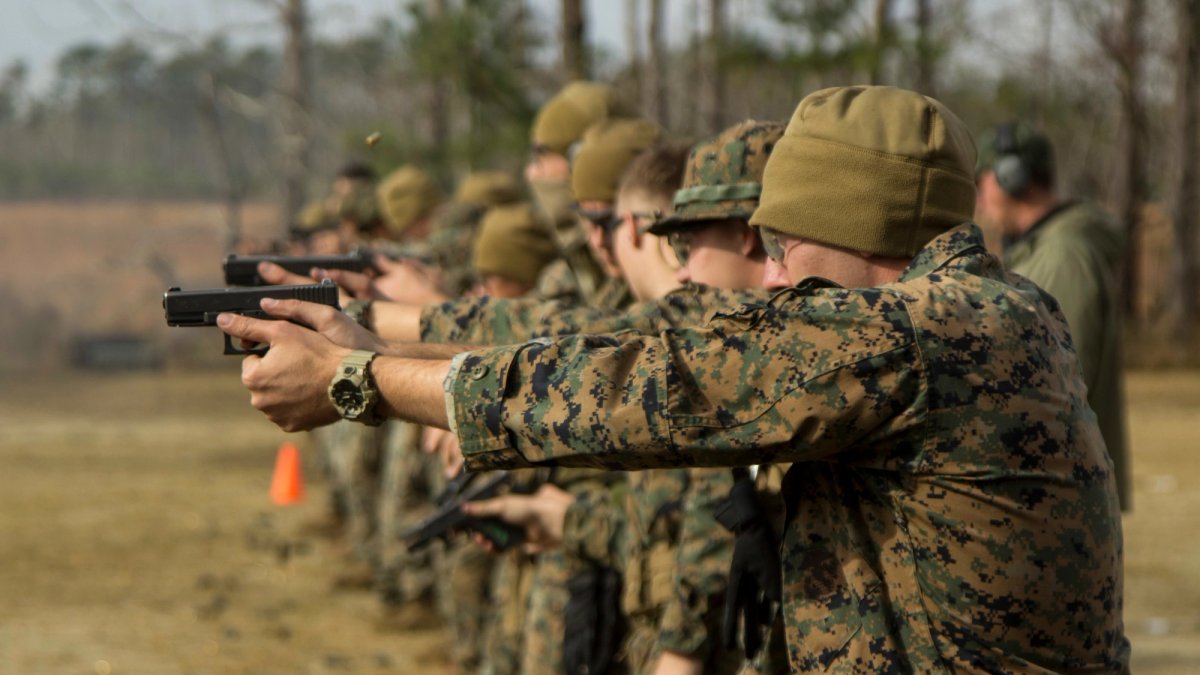
If one of the two proposed bills introduced to committees in the House and Senate passes, current and former special operators will join law enforcement officers with the privilege to carry concealed firearms. Both House and Senate bills have been referred to the appropriate committees.
Representative Pat Harrigan (R-N.C.), himself a former Green Beret with three Republican co-sponsors, has introduced HR 8332, “Special Operations Forces Concealed Carry Act,” which aims to provide special operators with concealed carry privileges. In the Senate, Sen. Tim Sheehy (R-Mont.) introduced a similar bill, S. 5208, with the same title.
In his April 16, 2026 press release announcing the bill, Rep Harrigan said,
"Federal law already trusts retired police officers to carry concealed nationwide... This bill fixes that. It does not create new rights or weaken any safeguard."
What Does the House Bill Say?
H.R. 8332 attempts to change 18 USC 926C, the Law Enforcement Officers Safety Act (LEOSA), which since 2004 has allowed qualified retired law enforcement officers to carry concealed firearms nationwide regardless of state law. The bill creates a parallel category, "qualified special operator," and adds it as an additional category. It’s worth noting that many current and former military police officers are already protected under LEOSA, and that Rep Harrigan and Sen Sheehy both mentioned this in their bills' introductory remarks.
The new eligibility criteria under 18 USC 926C under Harrigan's bill apply to current and former special operators of the grades of E5–E9, W1–W5, or O1–O10 with a DD-214 or service record showing duty in one of the listed military specialties. Those specialties include the Army Special Forces, service in the 75th Ranger Regiment, Navy SEALs, Marine Corps Force Recon/MARSOC, Air Force Special Warfare, and 1st SFOD-D with skill identifier "T."
The House bill does not require annual requalification, which is different from what LEOSA requires of retired law enforcement officers. Once issued, Harrigan’s bill makes the concealed carry credential permanent and not renewable. It will become contingent only on having an honorable discharge status "as applicable," maintaining qualified-special-operator status, and remaining federally eligible to possess a firearm. The bill states authority "terminate[s] immediately" if any of those lapse, but as written specifies no mechanism for determining or reporting a lapse.
Under HR 8332, the concealed carry license Identification would be either a DoD/VA-issued photo ID confirming status, or a valid government photo ID plus service documentation. The DoD and VA would have 180 days from the date of enactment to stand up the ID program, and the United States Attorney General would be required to issue interim guidance to law enforcement nationwide on accepting service documentation before the ID cards exist within 90 days of enactment.

The Companion Senate Bill Has More Details
Sen. Tim Sheehy (R-Mont.) has introduced a Senate companion, S. 5208, with the same title. This legislation would require an annual firearms requalification at the individual's own expense, as well as completion of a Department of Justice-certified "Concealed Carry Use of Force in Society" course, which is a requirement not in the House bill.
That's the biggest difference between the two bills. The House bill explicitly exempts qualified special operators from LEOSA's annual firearms-requalification requirement and states explicitly that "no separate certification of firearms training is required." In contrast, the Senate bill mandates the individual, at their own expense, to meet annual active-duty-equivalent firearms qualification standards at least once a year, and to complete a one-time Attorney General–certified "Concealed Carry Use of Force in Society" course covering civilian legal duties, reasonable-belief standards, and de-escalation. Failure to keep up either requirement terminates the Senate bill's authority immediately, since Sheehy's version folds both into the "continuing eligibility" test. The House bill has no such enforcement mechanism.
Gavin Glasenapp, the Training Operations Manager at Delta Defense for the U.S. Concealed Carry Association (USCCA), explained that while his organization supports the legislation, they fundamentally oppose government-mandated training requirements like those in the Senate bill. However, he emphasized that operators must be aware of the gap in their knowledge of civilian law.
"When it comes to self-defense, it's a perishable skill set. Not just the physical, tactile skills, but also knowledge of local, state, and federal law," Glasenapp said.
"We would never advocate for any kind of mandatory training, but we would still highly encourage that you have the personal responsibility to pursue a lifetime of education and training."
Glasenapp also noted that military training does not automatically translate to the streets of America.
"Get familiar with the civilian context," Glasenapp advises special operators transitioning to civilian life. "Get familiar with your local, state, and federal laws as they apply to you carrying now as a civilian back here at home."
Besides the training requirement, the other major difference between the House and Senate bills is the definition of who qualifies. Harrigan’s bill designates qualified servicemembers by unit, specialty, and pay grades and explicitly covers "current or former" service members. The Senate bill instead defines the term categorically, by reference to U.S. Special Operations Command's own classification: anyone who attended SOF assessment and selection and was awarded a special-warfare or special-operations MOS or skill designator "as defined by USSOCOM." Sheehy’s bill does not set any pay grade floors for qualification, and limits the provision to former servicemembers. Sheehy’s bill also includes Special Warfare Combatant-Craft Crewmen and their warrant officers.
Lastly, the Senate bill adds an ongoing eligibility clause to its list of conditions for retaining the qualification.

Voices on Record
So far, Harrigan’s bill has gotten two endorsements. In his announcement press release, Harrigan quoted Sean Williamson, Executive Director of ATLAS Rescue, who endorsed the bill:
“Atlas Rescue enthusiastically supports this legislation recognizing Special Operations veterans for their unique skills and service to our country. This recognition strengthens our ability to deploy highly trained operators in the fight against human trafficking, enabling us to more effectively bring that expertise to missions that protect the vulnerable and dismantle trafficking networks.”
According to their website, ATLAS Rescue is made up of former US special operators who find and eliminate “human trafficking, slavery, and child labor.”
Opposition, however, comes from the organizations associated with both the firearms rights and gun control advocates. While neither the Fraternal Order of Police nor the International Association of Chiefs of Police has a public position on Harrigan's or Sheehy’s bills, according to their websites, neither is on record as supporting them.
Gun rights advocate and podcaster Cam Edwards wrote that the bill “is a step in the wrong direction” in a piece at Bearing Arms. He believes that “national right-to-carry reciprocity is the answer,” echoing what proponents of the bill have also stated.
Status of the Bills
As of August 2026, H.R. 8332 has been referred to committee, specifically the Judiciary Committee, though some reports indicate that the Armed Services and Veterans' Affairs will take it under consideration. Currently, there is no public record of a scheduled hearing or markup for this bill.
Whether Congress ends up deciding to merge these bills, mandate annual training, or abandon the effort entirely, the conversation highlights a growing push to grant the nation's most highly trained Veterans the same trust granted to retired police officers.
The Brady Campaign and Gabrielle Giffords' office were reached for a statement, but did not respond to a request for comment prior to publication.
Continue Reading

DoD Aims to Transform Moves With a Standalone Agency by the End of 2026
Prepare for TRICARE Open Season 2026: Key Dates and Why You Should Enroll Early
The Race is On: States Compete to Host Hegseth’s ‘Next Great American Base’
Join the Conversation

Mickey Addison
Military Affairs Analyst at MyBaseGuide
Mickey Addison is a retired U.S. Air Force colonel and former defense consultant with over 30 years of experience leading operational, engineering, and joint organizations. After military service, h...
Mickey Addison is a retired U.S. Air Force colonel and former defense consultant with over 30 years of experience leading operational, engineering, and joint organizations. After military service, h...
Credentials
- PMP
- MSCE
Expertise
- defense policy
- infrastructure management
- political-military affairs
SHARE: