All Sailors and Marines Will Soon Have to Take a Yearly Gas Mask Fit Test

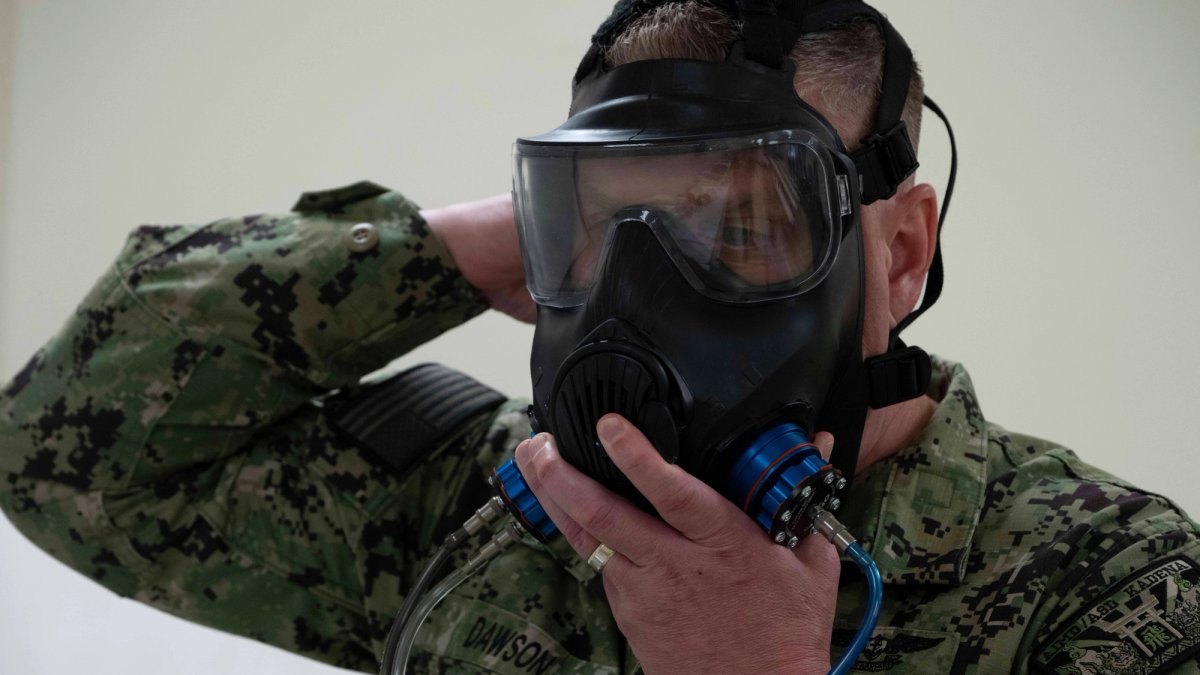
The Navy and Marine Corps have each issued formal directives requiring every active-duty and reserve service member to complete an annual chemical, biological, radiological, and nuclear (CBRN) protective mask fit test, with compliance deadlines beginning this month and running through the end of the year.
The Navy's order came first, published as NAVADMIN 200/26 on August 20, 2026, under the subject line "Implementation of Mandatory Annual CBRN Protective Mask Fit Training and Testing." The Marine Corps followed a day later with MARADMIN 384/26, signed August 21 by Lieutenant General Jay M. Bargeron, the Deputy Commandant for Plans, Policies, and Operations.
Together, the two messages formalize what had previously been treated in many commands as a periodic or unit-scheduled requirement into a standing annual obligation, tracked by name in official readiness systems, for every Sailor and Marine regardless of occupational specialty.
What the Messages Require
The Navy's NAVADMIN describes the requirement of an annual mask fit and seal training as a measure that,
"Supports individual readiness, validates the effective employment of respiratory protective equipment, supports survivability, interoperability and mission execution."
The message adds that
"The safe and proper utilization of protective equipment in all naval environments and operational conditions is critical to the operational success of the U.S. Navy."
Under the Navy's plan, training must include a fit test with a negative pressure seal check, preventive maintenance of the assigned mask, proper donning and adjustment of the equipment according to manufacturer instructions, and confidence training where applicable. The message sorts commands into duty-type categories with staggered deadlines: units in Duty Type II and IV were required to report completion by August 28, while units in Duty Type I, III, and VI were required to submit implementation plans by that same date, with full completion required by December 31, 2026.
Beyond this initial rollout, the Navy has set a recurring annual reporting deadline of August 31 of each fiscal year going forward, making this the first cycle of what commanders should expect to become a permanent fixture on the training calendar.
The Marine Corps' version, MARADMIN 384/26, is built around similar goals but uses the service's own training-tracking infrastructure. The message states plainly that,
"All Marines, active and reserve component, shall complete annual mask fit and seal testing to validate the ability to achieve an effective seal on approved respiratory protective equipment."
Marines can satisfy the requirement either by completing an Individual Protective Equipment Confidence Exercise or, for commands without an authorized allowance of Joint Service General Purpose Masks, by conducting a negative pressure seal check as the minimum acceptable standard. Approved masks under the directive include the M50 and the M53A1 Joint Service General Purpose Mask.
Completion status is tracked in the Marine Corps Training Information Management System using one of three designations: Trained, Untrained, or Failed. Commands were directed to validate every Marine's training status in that system by August 31, 2026. O-6-level commanders overseeing units with untrained personnel then have until September 30, 2026, for the active component and December 31, 2026, for the reserve component, to submit compliance plans describing how those Marines will be brought current.

The Grooming Standards Seal Requirement
Both messages tie the fit-testing requirement to a second, more contentious condition: personnel must be clean-shaven at the point where the mask meets the skin in order for a test to count.
The Marine Corps directive states it without qualification:
"Personnel shall be clean-shaven at the respirator seal surface when undergoing required annual CBRN testing or training."
The Navy's message carries the same expectation, framed around ensuring "the proper use and effectiveness of protective breathing equipment is not compromised." Neither service is asserting a new scientific finding. A poor seal caused by facial hair at the mask's contact points has long been documented as a factor in protective-mask performance, and prior editions of both services' CBRN training guidance have referenced clean-shaven seal surfaces as a testing prerequisite.
What is new is the direct, service-wide linkage between that requirement and an active enforcement mechanism, at a moment when facial-hair policy across the Department of Defense has become considerably less permissive than it was two years ago.
That shift traces to an August 20, 2025, memorandum from Secretary of Defense Pete Hegseth ordering strict enforcement of clean-shaven grooming standards across every military service. In comments accompanying the policy, Hegseth said:
"The grooming standard set by the U.S. military is to be clean-shaven and neat in presentation for a proper military appearance."
The memo gave the services a short window to bring existing shaving-waiver populations into compliance and set in motion a broader review of who qualifies for an exception, whether for medical or religious reasons. A Pentagon official described the policy as effective immediately, while noting that individual case reviews by medical providers and commanders would determine the actual timeline each affected service member faced.
The Navy has since translated that directive into service-specific guidance. NAVADMIN 162/26, issued this summer, capped medical shaving waivers at a total of twelve consecutive months, administered through individual treatment plans issued in increments of up to 90 days. The associated fact sheet states that "medical waivers are authorized only for prescribed medical treatment" and that "sailors reporting for duty without a current, approved waiver are required to be clean-shaven."
It further specifies that any medical waiver that remains in effect limits facial hair growth to a quarter of an inch. Under the policy, commands may recommend administrative separation for sailors unable to meet the standard "after receiving 12 consecutive months of medical treatment," though the fact sheet notes that separations tied to the policy will not begin until a full year after the NAVADMIN's release. Religious accommodations were explicitly carved out as unchanged by that particular message, even as a separate March 2026 Pentagon memo set a stricter review process for religious beard exemptions across the department, and a Sikh Marine's legal challenge over religious accommodation has continued to work through the courts.
The Navy has also moved to keep the waiver population itself under closer, recurring observation. NAVADMIN 180/26, released July 31, 2026, under the subject "Updated Guidance on Grooming Standards and Religious Liberty," directed every command to submit a monthly "Facial Hair Accommodation Accountability Report" by the 15th of each month, beginning in August, listing each service member with an active medical facial-hair accommodation along with the date their commanding officer signed the waiver form and the date it expires. The message states that "shaving waivers shall be aligned with the duration of prescribed medical treatment plan unless operational requirements warrant interruption," reinforcing the 12-month outer limit set in NAVADMIN 162/26 and giving the Navy a standing, updated roster of exactly who holds an approved waiver at any given command. That roster is the same population whose mask-fit-test results will now be entered into the training record required under NAVADMIN 200/26, giving commanders two parallel, monthly-to-annual data streams covering the same group of Sailors.
The Marine Corps has done this as well. Earlier guidance from the service addressed exemption requests to the annual mask-training requirement directly, according to background language in MARADMIN 384/26, which notes the directive builds on prior guidance regarding grooming standards for equipment compatibility and on the denial of exemptions to annual mask-fit training. In practical terms, the new mask-fit-testing messages give both services a recurring, individually documented data point that can be used to evaluate whether a service member's facial hair is compatible with assigned protective equipment, feeding into the same waiver and compliance framework established over the past year.

Why Now and What Happens Next?
When viewed alongside the broader run of grooming-standards guidance issued since August 2025, these mandates represent the operational half of a policy that has so far been debated mostly in terms of appearance and administrative process. Both services have built in monitoring layers to keep the initial rollout on schedule.
The Navy's recurring August 31 fiscal-year reporting deadline means unit-level completion rates will be visible to chains of command on an annual cycle going forward, not just during this first push. The Marine Corps' three-tier MCTIMS status gives commanders a standing, service-wide dataset broken out by individual Marine rather than by unit average, and the requirement for O-6 commanders to personally submit compliance plans for units with untrained personnel puts accountability for the initial rollout at a command level well above the individual company or division.
Many are wondering whether this new requirement will result in disciplinary action for service members who cannot obtain a seal on their gas mask. According to the Navy, the focus remains largely administrative.
A Navy spokesperson explained that “This tracking is for training and certification rather than a pass/fail personnel action, and no punitive measures are outlined in the policy for test outcomes.”
For the remainder of 2026, the compliance calendar runs on two tracks. On the Navy side, units in Duty Type I, III, and VI have through December 31 to reach full completion after submitting implementation plans in late August, while the Type II and IV population was expected to have already reported completion by August 28.
On the Marine Corps side, active-component units have through September 30 to submit compliance plans for any Marine listed as untrained following the August 31 MCTIMS validation, with reserve units carrying a December 31 deadline that mirrors the Navy's shore-duty cutoff.
Continue Reading

A 3.6% COLA Increase Is Coming in 2027: How Much Extra Is Hitting Your Paycheck?

Navy Voting Stand Down 2026: Your Rights, Resources, and What to Expect

Planning a TDY or PCS? Here Is How the 2027 Per Diem Rates Affect Your Wallet
Join the Conversation

Mickey Addison
Military Affairs Analyst at MyBaseGuide
Mickey Addison is a retired U.S. Air Force colonel and former defense consultant with over 30 years of experience leading operational, engineering, and joint organizations. After military service, h...
Mickey Addison is a retired U.S. Air Force colonel and former defense consultant with over 30 years of experience leading operational, engineering, and joint organizations. After military service, h...
Credentials
- PMP
- MSCE
Expertise
- defense policy
- infrastructure management
- political-military affairs
SHARE: